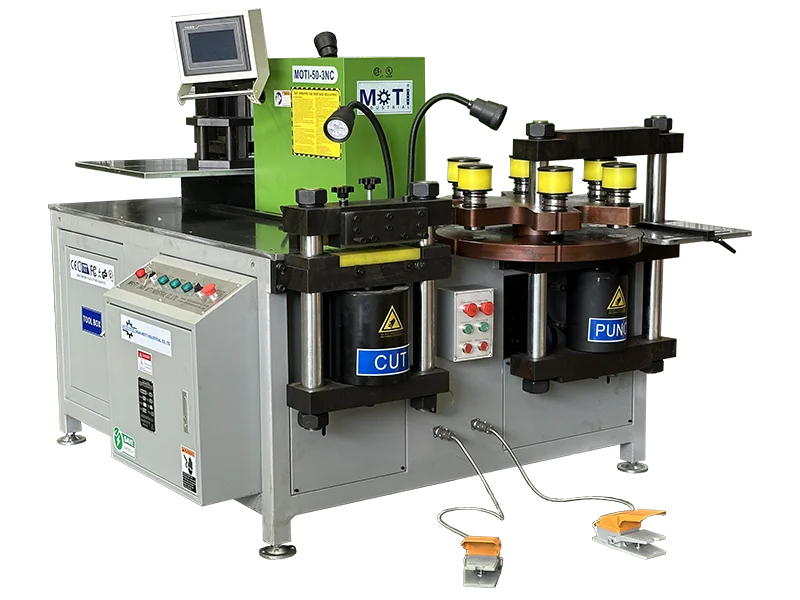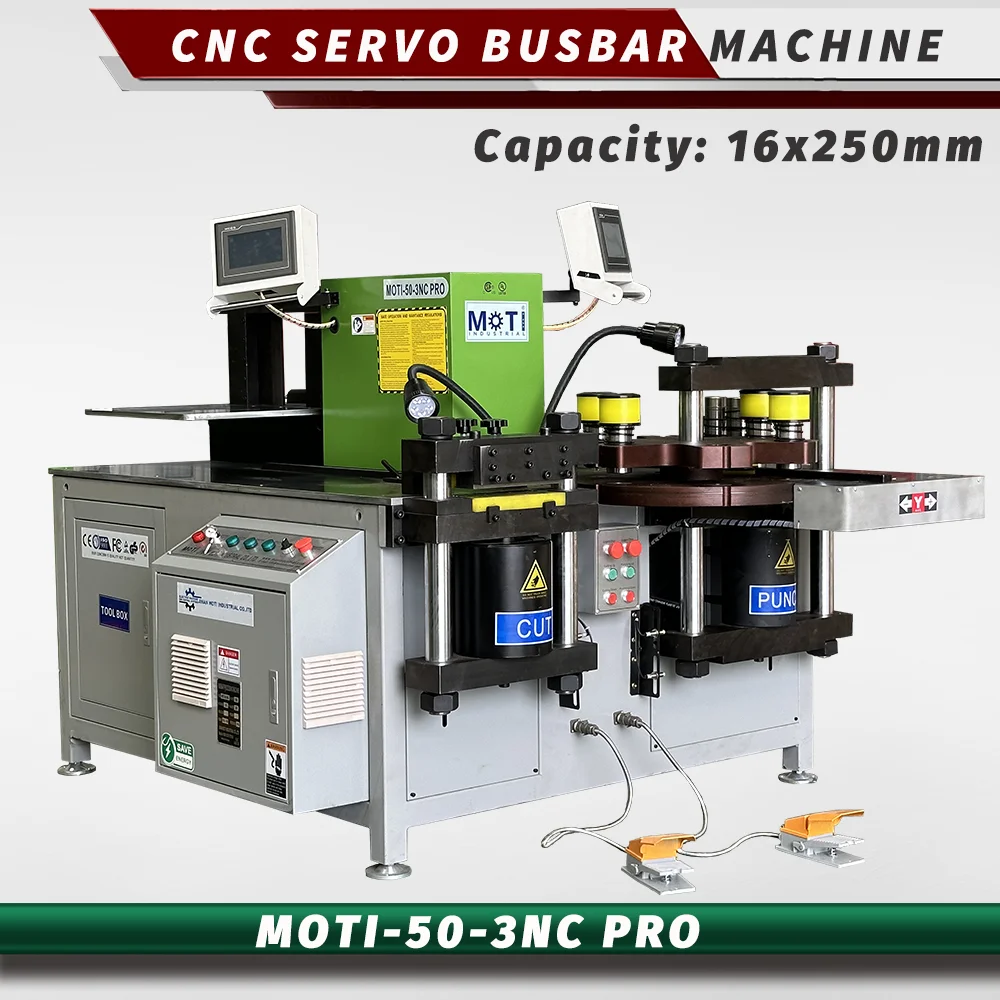
| What to compare | 50-3NC | 50-3NC PRO |
|---|---|---|
| Main capacity | 16 × 250 mm | 16 × 250 mm |
| Positioning | Operator setup; CNC bending control | Four servo positioning axes |
| Cutting X travel | Check supplied gauge | 1,000 mm |
| Punching X / Y travel | Check positioning arrangement | 500 / 1,000 mm |
| Bending gauge travel | Check supplied gauge | 500 mm |
| Workpiece handling | Operator handling | Operator handling |
| Motor power | 3 × 5.5 kW | 3 × 5.5 kW |
Standard 50-3NC: the three-process workstation
The standard machine combines cutting, punching and bending. Review the operator’s actions at each station and the way dimensions and bending angles are set. The CNC label alone does not imply automatic feeding at every station.
50-3NC PRO: four servo positioning axes
The published PRO specification lists a 1,000 mm cutting X axis, 500 mm punching X axis, 1,000 mm punching Y axis and 500 mm bending gauge. These are positioning travels, not stock-length or all-direction processing capacities.
Choose using a repeated job
Use the same drawing, material and tooling assumptions for both demonstrations. Record setup, dimension changes, part transfer, checking and the repeated part cycle. Assess the required positioning assistance against the work you actually repeat.
When to discuss a separate bending center
If the main bottleneck is bending geometry or programming, discuss the NC.40Z series alongside separate punching and cutting equipment. Verify your file format and version with a real import demonstration before choosing a software workflow.
Where positioning assistance can matter
Consider a batch with repeated cut lengths, several hole centers and a recurring bend reference. Each dimension creates an operator setting to make and check. The PRO’s gauges address those settings. If the production mix is mostly small one-off jobs, include program preparation and changeover in the comparison rather than counting only the repeated cycle.
What remains part of the operator’s work
The bar must still be loaded, held against the correct reference, moved between operations and inspected. Long bars need support and a safe working layout. A positioning axis does not supply an automatic material-handling system.
Compare the whole purchase
Review the included dies, software and controller version, power, spare-tool requirements and training scope. Ask to see how a setting is changed and how a previous job is recalled. Choose based on the work and support you need, using a quotation for the exact configuration.